














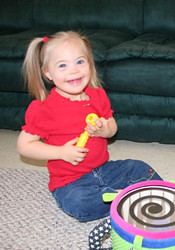
Because of her enunciation Kayla's speech sometimes takes some deciphering to figure out what she is saying. Thankfully she is usually able to describe it with other words, or point to an object, or act it out so we finally get that 'a ha!' moment.
We had just such a moment the other day when I picked her up from school.
I told her she had some homework/studying to do of her vocabulary words and said, "You know your list? Like 'visible'?"
Kayla, "Yeah I know that."
Me, "This week your words all end in either 'able' or 'ible' so we've got to study those."
K, "Lovable!"
M, "Yep, lovable, that's one of your words."
K, "And (insert word that I thought sounded like 'likable').
M, "Likable?"
K, "No, (repeats word that still sounds an awful lot like 'likable')"
M, "LIKE ABLE? Is that what you're saying?"
K, "No, (repeats word), you know? Like this?" - She lifts up her leg and rubs her hand on the side of it. "LEG" ible."
Me, busting out laughing because I get it now.
M, "OH! Kayla that's 'legible' - what your handwriting is not! It's not pronounced "LEG"ible! It's leh-gible""
K, "Ooooh!"
And then we both got a good laugh out of that.
She knew the word began with LEG and thought it was pronounced that way. It really was funny when she knew I was saying "likable" and she knew that wasn't the word she was saying so she pointed out her leg since she thought it had to do with 'leg'. Ha!
Showing posts with label speech. Show all posts
Showing posts with label speech. Show all posts
Thursday, October 12, 2017


Tuesday, March 08, 2016
She is Eris, Goddess of Chaos
In Social Studies Kayla's class is studying Ancient Greece. One of their assignments was to be assigned a Greek god or goddess and do a research report and a presentation as that god/goddess as part of a "Greek Museum" day.
Kayla's goddess was Eris: The Goddess of Chaos.
Her research paper was only a few paragraphs long, which was fine. It included the required elements of a cover page and the information of what they were the god/dess of, their symbol, parents, something important about them and a story or two. Some of the god/dess have enough stories to fill a book, and others only have a mere mention here or there. Kayla's goddess was one of those.
We got the gist of the report done by gathering information, but now came typing it up. I wanted Kayla to do as much of the project as she could - I didn't want to be the one typing for her. She doesn't have a lot of experience typing ... and she is definitely still in that one-finger-hunt-and-peck mode of typing. I knew this would take a while for her to type up a report.
I tried doing speech to text on my computer; however it failed to correctly type what she said about 99% of the time. It wasn't worth it if I had to correct just about everything it came up with. I'm sure there are better accessible ways for Kayla to successfully produce a typed report, but it wasn't happening on this one. (Any suggestions out there?)
It took us several days but she did type it out by herself, so even if I helped with the sentence structure, she did the actual work of typing the report.
Now for the Greek Museum presentation. It was basically the same as the report. They had to be dressed as their god/dess and when someone stepped on their 'button' they would come 'alive' and say who they were, what they were known for, and an interesting/important story.
Kayla knew the info about her goddess: Eris' parents, her symbol of a Golden Apple, and her story about the Golden Apple.

I went to school to watch her do her part in the museum. When I first walked in the room Kayla was giving her story, as were most of the other students, to small groups of Kindergartners. I listened to Kayla telling about Eris, the Goddess of Chaos and when she was done I was a little saddened because while I knew the story about Eris and the apple (having researched it with her) and what she was saying, I realized that none of those kids probably understood much of what she said or could tell you anything other than she had an apple.
She was participating and doing her part and knew her material ... but I didn't think it was getting across to the audience. I wished she could speak clearer. I wished she had better sentence structure. I wished the kids would know what she was talking about.
Then I walked around to listen to the rest of the 6th graders tell their stories. After hearing them tell their stories I had a revelation.
I only understood about 10% of what I heard regarding the Greek god/dess.
I realized that I couldn't understand most of what the other students were saying either. It was loud in the room with several presentations going on at once, they talked too quietly, they talked too quickly, they mumbled, they had full beards that covered their mouths which impeded their voice, they looked down to read off their index cards and their voices got lost.
I'm sure that the group of young students I first observed around Kayla probably didn't understand most of what any of the other students were telling them either. I mentally kicked myself for being overly critical of Kayla's performance ... for worrying too much.
Sometimes I need the reminder that she fits right in with the rest of her peers.
I took a video, but right before this I mentioned to her that one of her classmates was Ares, the God of War - and her brother. That little tidbit distracted her from what she had been saying so I tried to bring her back on track. I also missed the very beginning where she says that Zeus is her father and Hera is her mother.
The story she tells is that she was mad and jealous because she wasn't invited to a wedding so she threw the Golden Apple into the wedding and the apple had "For the fairest" on it.
Kayla's goddess was Eris: The Goddess of Chaos.
Her research paper was only a few paragraphs long, which was fine. It included the required elements of a cover page and the information of what they were the god/dess of, their symbol, parents, something important about them and a story or two. Some of the god/dess have enough stories to fill a book, and others only have a mere mention here or there. Kayla's goddess was one of those.
We got the gist of the report done by gathering information, but now came typing it up. I wanted Kayla to do as much of the project as she could - I didn't want to be the one typing for her. She doesn't have a lot of experience typing ... and she is definitely still in that one-finger-hunt-and-peck mode of typing. I knew this would take a while for her to type up a report.
I tried doing speech to text on my computer; however it failed to correctly type what she said about 99% of the time. It wasn't worth it if I had to correct just about everything it came up with. I'm sure there are better accessible ways for Kayla to successfully produce a typed report, but it wasn't happening on this one. (Any suggestions out there?)
It took us several days but she did type it out by herself, so even if I helped with the sentence structure, she did the actual work of typing the report.
Now for the Greek Museum presentation. It was basically the same as the report. They had to be dressed as their god/dess and when someone stepped on their 'button' they would come 'alive' and say who they were, what they were known for, and an interesting/important story.
Kayla knew the info about her goddess: Eris' parents, her symbol of a Golden Apple, and her story about the Golden Apple.

I went to school to watch her do her part in the museum. When I first walked in the room Kayla was giving her story, as were most of the other students, to small groups of Kindergartners. I listened to Kayla telling about Eris, the Goddess of Chaos and when she was done I was a little saddened because while I knew the story about Eris and the apple (having researched it with her) and what she was saying, I realized that none of those kids probably understood much of what she said or could tell you anything other than she had an apple.
She was participating and doing her part and knew her material ... but I didn't think it was getting across to the audience. I wished she could speak clearer. I wished she had better sentence structure. I wished the kids would know what she was talking about.
Then I walked around to listen to the rest of the 6th graders tell their stories. After hearing them tell their stories I had a revelation.
I only understood about 10% of what I heard regarding the Greek god/dess.
I realized that I couldn't understand most of what the other students were saying either. It was loud in the room with several presentations going on at once, they talked too quietly, they talked too quickly, they mumbled, they had full beards that covered their mouths which impeded their voice, they looked down to read off their index cards and their voices got lost.
I'm sure that the group of young students I first observed around Kayla probably didn't understand most of what any of the other students were telling them either. I mentally kicked myself for being overly critical of Kayla's performance ... for worrying too much.
Sometimes I need the reminder that she fits right in with the rest of her peers.
I took a video, but right before this I mentioned to her that one of her classmates was Ares, the God of War - and her brother. That little tidbit distracted her from what she had been saying so I tried to bring her back on track. I also missed the very beginning where she says that Zeus is her father and Hera is her mother.
The story she tells is that she was mad and jealous because she wasn't invited to a wedding so she threw the Golden Apple into the wedding and the apple had "For the fairest" on it.
Friday, October 31, 2014
Not A Role Model Mom
Throughout Kayla's eleven years I've often had people remark to me with some variation of the following expressions:
"She is doing so well, you must work with her so much at home."
"She's doing great, it must be what you're doing at home."
"It really shows that you work a lot with her."
"So much of what she's doing is because of what you do at home."
"It's obvious you do a lot with her."
As I'm wondering what their definition of doing 'so well' means, and what ideas/expectations they had of what they expect someone with Down syndrome to be doing, or not doing, I smile, through gritted teeth, and swallow the guilt bubbling up inside of me. I feel like an imposter accepting these accolades.
The truth is: I'm not "doing" that much with her at home. The truth is: I am not a role model parent to look to when it comes to raising a child with a disability. The truth is: There is so much I could be doing better with her. The truth is: I haven't done anything above and beyond.
I don't have much confidence in myself as a parent, much less trying to be a teacher and therapist too. So I don't teach (often, or that well), and I don't stay on top of therapies as often as I should. Instead, I just try to stay afloat with this parenting gig.
I have always found it not so easy to try and "do things" with Kayla - you know, those educational things to keep her on track and progressing. Even when she was a toddler I often became flustered and I guess gave up easily. I don't make up flash cards or turn everything in to an educational game. I don't stay consistent with reviewing math facts.
I became overwhelmed at all the products aimed at kids with disabilities. Not only was it overwhelming, but it can be expensive. I looked at numerous reading programs but always balked at the prices and thought I could just recreate my own at home; except I never got around to doing that.
At our first NDSC Convention in Boston we bought a DVD of school readiness activity type things, but that meant we would have to print off all the pages. And there are a lot of pages. Pages and pages and pages. Joe printed off several of these units but at the time they were still a little advanced for Kayla. Then he deployed and they got packed up to storage. By the time we got them out of storage and thought about them again she was beyond those skills.
I bought the Numicon set, but I think I must've bought a very basic set (expenses you know!) because I don't have any big handbook of activities or how to really use it successfully. I have a small fold out activity booklet, but I know there is more to it than that. So it sits, hardly being used.
Once Kayla started school it became even more difficult to "do things" with her at home. When she comes home from school she is done. Throw in after school activities and therapies and time is even more limited.
At one point Kayla was going to vision and speech therapy 2x a week each after school. Girl Scouts 2x a month, Drama Club 1x a week after school, and Running Club 1x a week after school (although not the whole year).
We are supposed to do 'home exercises' from speech and vision therapy activities. In theory this shouldn't take long. We can squeeze in 10-15 for each therapy several times a week, right? Not so much.
After school she wants to unwind. I get that. She needs time to let her mind be free of all that learning. She wants to be upstairs or outside playing. And I let her; I let her play. But it is not easy to reign her back in and tell her she has to stop playing so we can do x,y,z. And then if we get one thing done I have to let her take a break and then go through the process of reigning her back in again. Outside for 30 min, inside to work on things, back outside for another 30 min? It simply doesn't work that well.
There are speech and vision activities, reading every day, general reviewing of information from science/social studies, study for quizzes/tests, attempting to do math, practicing handwriting. It feels like a constant, "Kayla do this, do that, we've got to study this, let's work on that, sit down and do this."
It seems like there should be enough time to do a little bit here or there, but it never works out that way. 15 min of vision exercises can turn in to 30 min after counting the time it takes to convince her to do it and go sit at the table, after all the breaks in between for being distracted, for fidgeting, for getting some water, for going to the bathroom. That's the same for anything structured we try and do. The process takes so much longer than it should.
If I feel overwhelmed and stressed at the constant "let's do this and this and this and work on this and this and this" how must she feel as the one being told to do all that?
Sometimes I feel like she must think that's all she hears. "Corrections to her speech and tongue placement. Time to read a book. Let's do Xtra Math on the computer. Let's review notes from science and social studies. Count by 10s. By 1s. By 5s. Let's do the multiplication game where you get the guy to climb the mountain. Read your phrase book. Work on your speech exercises. Get out your vision therapy glasses and let's do the number chart. You should practice writing some words." and on and on and on it goes.
She just wants to be a kid. She just wants to play. She just wants to be free to do what she wants to do.
And most of the time I let all the other stuff go and let her be a kid. Most of the time she plays outside longer than I intended because it's a nice day and the other kids are out and I don't want to call her inside to do more work or therapy.
So no, I don't do much with her at home. I don't drill her. I don't make flash cards. I don't make up games to work on skills. I try to introduce things, but am usually met with resistance and I don't want everything to be a fight.
We do what we can every night, but I know there's a lot I'm not doing. I wonder how much "better" she could be doing if I were more consistent. It I were a better teacher and therapist. If I just knew how to do things with her.
But I want her to enjoy her childhood, too.

"She is doing so well, you must work with her so much at home."
"She's doing great, it must be what you're doing at home."
"It really shows that you work a lot with her."
"So much of what she's doing is because of what you do at home."
"It's obvious you do a lot with her."
As I'm wondering what their definition of doing 'so well' means, and what ideas/expectations they had of what they expect someone with Down syndrome to be doing, or not doing, I smile, through gritted teeth, and swallow the guilt bubbling up inside of me. I feel like an imposter accepting these accolades.
The truth is: I'm not "doing" that much with her at home. The truth is: I am not a role model parent to look to when it comes to raising a child with a disability. The truth is: There is so much I could be doing better with her. The truth is: I haven't done anything above and beyond.
I don't have much confidence in myself as a parent, much less trying to be a teacher and therapist too. So I don't teach (often, or that well), and I don't stay on top of therapies as often as I should. Instead, I just try to stay afloat with this parenting gig.
I have always found it not so easy to try and "do things" with Kayla - you know, those educational things to keep her on track and progressing. Even when she was a toddler I often became flustered and I guess gave up easily. I don't make up flash cards or turn everything in to an educational game. I don't stay consistent with reviewing math facts.
I became overwhelmed at all the products aimed at kids with disabilities. Not only was it overwhelming, but it can be expensive. I looked at numerous reading programs but always balked at the prices and thought I could just recreate my own at home; except I never got around to doing that.
At our first NDSC Convention in Boston we bought a DVD of school readiness activity type things, but that meant we would have to print off all the pages. And there are a lot of pages. Pages and pages and pages. Joe printed off several of these units but at the time they were still a little advanced for Kayla. Then he deployed and they got packed up to storage. By the time we got them out of storage and thought about them again she was beyond those skills.
I bought the Numicon set, but I think I must've bought a very basic set (expenses you know!) because I don't have any big handbook of activities or how to really use it successfully. I have a small fold out activity booklet, but I know there is more to it than that. So it sits, hardly being used.
Once Kayla started school it became even more difficult to "do things" with her at home. When she comes home from school she is done. Throw in after school activities and therapies and time is even more limited.
At one point Kayla was going to vision and speech therapy 2x a week each after school. Girl Scouts 2x a month, Drama Club 1x a week after school, and Running Club 1x a week after school (although not the whole year).
We are supposed to do 'home exercises' from speech and vision therapy activities. In theory this shouldn't take long. We can squeeze in 10-15 for each therapy several times a week, right? Not so much.
After school she wants to unwind. I get that. She needs time to let her mind be free of all that learning. She wants to be upstairs or outside playing. And I let her; I let her play. But it is not easy to reign her back in and tell her she has to stop playing so we can do x,y,z. And then if we get one thing done I have to let her take a break and then go through the process of reigning her back in again. Outside for 30 min, inside to work on things, back outside for another 30 min? It simply doesn't work that well.
There are speech and vision activities, reading every day, general reviewing of information from science/social studies, study for quizzes/tests, attempting to do math, practicing handwriting. It feels like a constant, "Kayla do this, do that, we've got to study this, let's work on that, sit down and do this."
It seems like there should be enough time to do a little bit here or there, but it never works out that way. 15 min of vision exercises can turn in to 30 min after counting the time it takes to convince her to do it and go sit at the table, after all the breaks in between for being distracted, for fidgeting, for getting some water, for going to the bathroom. That's the same for anything structured we try and do. The process takes so much longer than it should.
If I feel overwhelmed and stressed at the constant "let's do this and this and this and work on this and this and this" how must she feel as the one being told to do all that?
Sometimes I feel like she must think that's all she hears. "Corrections to her speech and tongue placement. Time to read a book. Let's do Xtra Math on the computer. Let's review notes from science and social studies. Count by 10s. By 1s. By 5s. Let's do the multiplication game where you get the guy to climb the mountain. Read your phrase book. Work on your speech exercises. Get out your vision therapy glasses and let's do the number chart. You should practice writing some words." and on and on and on it goes.
She just wants to be a kid. She just wants to play. She just wants to be free to do what she wants to do.
And most of the time I let all the other stuff go and let her be a kid. Most of the time she plays outside longer than I intended because it's a nice day and the other kids are out and I don't want to call her inside to do more work or therapy.
So no, I don't do much with her at home. I don't drill her. I don't make flash cards. I don't make up games to work on skills. I try to introduce things, but am usually met with resistance and I don't want everything to be a fight.
We do what we can every night, but I know there's a lot I'm not doing. I wonder how much "better" she could be doing if I were more consistent. It I were a better teacher and therapist. If I just knew how to do things with her.
But I want her to enjoy her childhood, too.
Thursday, October 02, 2014
Talkitt - This Is My Voice
Most people with Down syndrome have some degree of speech and language disability. An additional diagnosis of speech apraxia makes speech especially difficult.
For some individuals, because of low muscle tone, it can be hard to enunciate certain letter sounds or combination of sounds. For the most part Kayla does a fairly well job of communicating and getting her point across. Sometimes she is better understood when the listener knows the context. Sometimes we still have to do 20 questions to try and figure out what she is saying....hence my post about Ms Frog had a Baby Snake!
There are assistive communication devices out there that can be programmed with sentences for the individual to press so they can ask and answer questions, but I don't think I've ever seen a solution to speech disabilities like Talkitt.
Talkitt is a software application, not a separate communication device, that allows people to easily communicate using their own voice. It "translates unintelligible pronunciation from any language into understandable speech." How amazing and empowering does that sound? For people who have a hard time being understood, to finally have their voice heard and understood?!
So just how does this work? By recognizing the user's vocal patterns and speaking their words in an understandable language allowing them to communicate easily with anyone and in any language they use. It is compatible with smart phones and tablets and in the future on laptops and computers.
Watch the video below for examples of people with speech disabilities using Talkitt and how it easily translates for them:
They have launched a crowdfunding campaign with a goal to raise $40,000 and are half-way to their goal, with a little over 2 weeks left for the campaign. This campaign page is full of information about Talkitt - go check it out for more details...it's really fascinating!
One of the questions near the bottom of the page asks, "Will it work with very severe speech disabilities?" and the answer is "Definitely. It works with any spectrum of speech severity from mild to extremely severe due to our innovative pattern recognition software."
If you donate to this campaign I like that one of the "perks" you can chose (the $25 level) is a gift from Cameron's Chocolates - chocolates made by a group of volunteers with genetic disorders and undefined cognitive or physical disabilities.
The projected date for the product release is for beta testers to have access in the 1st quarter of 2015 and released to the public in the 2nd quarter of 2015. Can you imagine how much of a game changer this has the potential to be for people with speech disabilities?
 Grab This Button
There are assistive communication devices out there that can be programmed with sentences for the individual to press so they can ask and answer questions, but I don't think I've ever seen a solution to speech disabilities like Talkitt.
Talkitt is a software application, not a separate communication device, that allows people to easily communicate using their own voice. It "translates unintelligible pronunciation from any language into understandable speech." How amazing and empowering does that sound? For people who have a hard time being understood, to finally have their voice heard and understood?!
So just how does this work? By recognizing the user's vocal patterns and speaking their words in an understandable language allowing them to communicate easily with anyone and in any language they use. It is compatible with smart phones and tablets and in the future on laptops and computers.
Watch the video below for examples of people with speech disabilities using Talkitt and how it easily translates for them:
They have launched a crowdfunding campaign with a goal to raise $40,000 and are half-way to their goal, with a little over 2 weeks left for the campaign. This campaign page is full of information about Talkitt - go check it out for more details...it's really fascinating!
One of the questions near the bottom of the page asks, "Will it work with very severe speech disabilities?" and the answer is "Definitely. It works with any spectrum of speech severity from mild to extremely severe due to our innovative pattern recognition software."
If you donate to this campaign I like that one of the "perks" you can chose (the $25 level) is a gift from Cameron's Chocolates - chocolates made by a group of volunteers with genetic disorders and undefined cognitive or physical disabilities.
The projected date for the product release is for beta testers to have access in the 1st quarter of 2015 and released to the public in the 2nd quarter of 2015. Can you imagine how much of a game changer this has the potential to be for people with speech disabilities?
Grab This Button
Friday, October 04, 2013
When Lellow Became Yellow
Like a lot of kids when they first start talking, Lucas pronounced "yellow" like "lellow."
I knew that he would eventually start saying it correctly, and as it got closer to him starting Kindergarten I knew I should be correcting him so he would enunciate it correctly. But I was hesitant, because I enjoyed how cute it sounded to hear "lellow" and when he would say it, it reminded me that he was still my little boy.
A few weeks before school started, out of nowhere, Joe asked Lucas, "What color is the sun?"
We both fully expected to hear "lellow" and I knew that we would secretly share a smile over his head.
Instead, also seemingly out of nowhere, he answered perfectly clearly, "yellow." Joe and I shared more of a shocked looked over his head when that came out of his mouth.
No one had been coaching him to pronounce it "yellow." No one had even brought it up to him. It just naturally flowed out of his mouth as if he had been saying "yellow" this whole time. Except he hasn't.
We asked him again, and again, what color is the sun? And he kept answering "yellow." He didn't realize what the big deal was; he didn't even realize he was saying it differently than he was previously saying it until we pointed it out to him.
Joe and I shared another look - one that said we were going to miss the sound of 'lellow' and that this was just another sign that he was growing up.
He still has a couple of other things that he says that I'm going to miss when he grows out of those as well.
He got 'scented' and 'sensitive' mixed up at one point. Kayla gave him a scented marker for Christmas last year and he got some on this thumb and said that his "thumb is sensitive now." So when talking about something that is scented he says sensitive. He, in turn, gave her a scented pen for her birthday, but it's "see Kayla? It's sensitive, just like the sensitive marker you gave me."
When something is confusing him he says, "Oh I'm confusing!" instead of "I'm confused."
Contents became mixed up with continents. "Where are the Table of Continents in this book?"
I need to start writing down more of his little language quirks before he stops saying them...and before he grows up too much.
I knew that he would eventually start saying it correctly, and as it got closer to him starting Kindergarten I knew I should be correcting him so he would enunciate it correctly. But I was hesitant, because I enjoyed how cute it sounded to hear "lellow" and when he would say it, it reminded me that he was still my little boy.
A few weeks before school started, out of nowhere, Joe asked Lucas, "What color is the sun?"
We both fully expected to hear "lellow" and I knew that we would secretly share a smile over his head.
Instead, also seemingly out of nowhere, he answered perfectly clearly, "yellow." Joe and I shared more of a shocked looked over his head when that came out of his mouth.
No one had been coaching him to pronounce it "yellow." No one had even brought it up to him. It just naturally flowed out of his mouth as if he had been saying "yellow" this whole time. Except he hasn't.
We asked him again, and again, what color is the sun? And he kept answering "yellow." He didn't realize what the big deal was; he didn't even realize he was saying it differently than he was previously saying it until we pointed it out to him.
Joe and I shared another look - one that said we were going to miss the sound of 'lellow' and that this was just another sign that he was growing up.
He still has a couple of other things that he says that I'm going to miss when he grows out of those as well.
He got 'scented' and 'sensitive' mixed up at one point. Kayla gave him a scented marker for Christmas last year and he got some on this thumb and said that his "thumb is sensitive now." So when talking about something that is scented he says sensitive. He, in turn, gave her a scented pen for her birthday, but it's "see Kayla? It's sensitive, just like the sensitive marker you gave me."
When something is confusing him he says, "Oh I'm confusing!" instead of "I'm confused."
Contents became mixed up with continents. "Where are the Table of Continents in this book?"
I need to start writing down more of his little language quirks before he stops saying them...and before he grows up too much.
Monday, June 10, 2013
Speaking Up
A couple of weeks ago I was in a situation where someone used the "r-word" in a conversation with me.
I was in a store, checking out, and found myself at the register with a guy who had the word "manager" on his name tag.
I scanned my shopper reward card and as my information came up on his screen he attempted to address me by my name. As he got to my last name he paused and stumbled a bit in trying to pronounce it. I said my last name for him.
That's when he said, "I have trouble pronouncing names, I just end up sounding retarded."
Say what?!
My mind is thinking: You're the manager of the store. You should present yourself as more professional, especially when you're checking out a customer you don't know. You really had to say that? You couldn't stop at just saying 'I have trouble pronouncing names.'
And what does that even mean? You have trouble pronouncing names so you sound retarded.
So you sound like someone who has an intellectual disability and has trouble speaking?
So you sound like someone who has an intellectual disability and low muscle tone which makes enunciating certain sounds difficult for them?
So you sound like someone like....hmmm...my daughter? Someone who does her best to speak her words and tries to get her brain to connect the dots between making her mouth, tongue, and lips all work in sync to come together for perfect speech ... yet it doesn't happen. There are still times we, her family, have trouble understanding her. Hence the whole "Ms Frog had a baby snake" conversation.
Of course this guy knew none of this. Kayla wasn't with me. He didn't know I have a daughter with an intellectual disability.
But the point is, there was no reason for him to make that comparison in the first place. There was no reason for him to compare his trouble pronouncing names with sounding 'retarded.'
Was he expecting me to laugh at his little joke and find that funny?
I didn't immediately say anything (you know, my issue with uncomfortableness in confronting someone about their usage of the r-word). But while he was finishing with my transaction I kept telling myself to "say something! Find your backbone! Speak up! Advocate! An opportunity presented itself for you to find your voice...use it!"
So I did. I wouldn't say I was eloquent. I didn't know what to say and I know I spoke quickly and stumbled over myself. I just said something like, "Next time could you not use the word retarded? I have a daughter who has an intellectual disability and I'd just ask that you think before using that word again."
Of course he was apologetic and appeared embarrassed. I think we both felt a bit awkward. But I did it. I finally spoke up. I finally let someone know how I felt after hearing them use the r-word. I finally found my voice and my backbone.
And maybe, just maybe, (and hopefully), he will think about it the next time he goes to casually throw out that word in a conversation.
I was in a store, checking out, and found myself at the register with a guy who had the word "manager" on his name tag.
I scanned my shopper reward card and as my information came up on his screen he attempted to address me by my name. As he got to my last name he paused and stumbled a bit in trying to pronounce it. I said my last name for him.
That's when he said, "I have trouble pronouncing names, I just end up sounding retarded."
Say what?!
My mind is thinking: You're the manager of the store. You should present yourself as more professional, especially when you're checking out a customer you don't know. You really had to say that? You couldn't stop at just saying 'I have trouble pronouncing names.'
And what does that even mean? You have trouble pronouncing names so you sound retarded.
So you sound like someone who has an intellectual disability and has trouble speaking?
So you sound like someone who has an intellectual disability and low muscle tone which makes enunciating certain sounds difficult for them?
So you sound like someone like....hmmm...my daughter? Someone who does her best to speak her words and tries to get her brain to connect the dots between making her mouth, tongue, and lips all work in sync to come together for perfect speech ... yet it doesn't happen. There are still times we, her family, have trouble understanding her. Hence the whole "Ms Frog had a baby snake" conversation.
Of course this guy knew none of this. Kayla wasn't with me. He didn't know I have a daughter with an intellectual disability.
But the point is, there was no reason for him to make that comparison in the first place. There was no reason for him to compare his trouble pronouncing names with sounding 'retarded.'
Was he expecting me to laugh at his little joke and find that funny?
I didn't immediately say anything (you know, my issue with uncomfortableness in confronting someone about their usage of the r-word). But while he was finishing with my transaction I kept telling myself to "say something! Find your backbone! Speak up! Advocate! An opportunity presented itself for you to find your voice...use it!"
So I did. I wouldn't say I was eloquent. I didn't know what to say and I know I spoke quickly and stumbled over myself. I just said something like, "Next time could you not use the word retarded? I have a daughter who has an intellectual disability and I'd just ask that you think before using that word again."
Of course he was apologetic and appeared embarrassed. I think we both felt a bit awkward. But I did it. I finally spoke up. I finally let someone know how I felt after hearing them use the r-word. I finally found my voice and my backbone.
And maybe, just maybe, (and hopefully), he will think about it the next time he goes to casually throw out that word in a conversation.
Friday, June 07, 2013
Ms Frog Had Baby Snake
What we heard Kayla say the first time:
"Ms Frog had a baby snake."
Process of elimination:
Someone had a baby snake?
Kayla: No... repeats her sentence.
Joe: The frog had a baby snake?
Kayla: No...repeat
Joe: A shake?
Kayla: No...
Me: Oh, Mrs. Vaughn?!
Kayla: Yes!
Lucas: She's saying Mrs. Vaughn had a baby snake.
Kayla: No! Mrs Vaughn had baby snake!
Joe: Snake? Shake?
Kayla: NO! Baby snake!
Me: OH! Ms Vaughn had baby JAKE!
Kayla: YEAH!
Mrs. Vaughn is Kayla's ST in school. Back in Feb she gave birth to her son, Jake. From the rest of the conversation Kayla was able to tell us that Mrs Vaughn brought baby Jake to school and Kayla got to hold him and Mrs. Vaughn took a picture.
Usually we can understand Kayla, but there are still times with some of her enunciation of words, that we play a guessing game as to what she is saying ...and we end up with a conversation like the one above.
"Ms Frog had a baby snake."
Process of elimination:
Someone had a baby snake?
Kayla: No... repeats her sentence.
Joe: The frog had a baby snake?
Kayla: No...repeat
Joe: A shake?
Kayla: No...
Me: Oh, Mrs. Vaughn?!
Kayla: Yes!
Lucas: She's saying Mrs. Vaughn had a baby snake.
Kayla: No! Mrs Vaughn had baby snake!
Joe: Snake? Shake?
Kayla: NO! Baby snake!
Me: OH! Ms Vaughn had baby JAKE!
Kayla: YEAH!
Mrs. Vaughn is Kayla's ST in school. Back in Feb she gave birth to her son, Jake. From the rest of the conversation Kayla was able to tell us that Mrs Vaughn brought baby Jake to school and Kayla got to hold him and Mrs. Vaughn took a picture.
Usually we can understand Kayla, but there are still times with some of her enunciation of words, that we play a guessing game as to what she is saying ...and we end up with a conversation like the one above.
Thursday, August 23, 2012
The Cello
I didn't get much info out of Kayla as to how her first day of school went besides her usual "Goooood!" I knew her desk was between J and S so I was able to ask her some questions about them.
"Who did you sit next to at lunch?"
"J."
"What else did you do today?"
"Recess!"
"Who did you play with at recess?"
"J!"
"What did you play?"
"A game."
"What game?"
"Went on the slide!"
I try to ask her other open-ended questions but rarely get any specific answers about what she actually did or anything that happened in class, or what they were learning about. Eventually I let the subject drop.
We have these 'conversation dinner cards' that are like a deck of cards with questions on them. That night I pulled them out and one of the questions was "What is your favorite sound?" (Mine was silence - ha!)
After Lucas talked about his (I think he said a barking dog) Kayla came out with "Cello!"
Not sure that I heard her correctly I asked, "Your favorite sound is a cello?"
"Yes!"
Wow did that seem to come out of the blue. And I said as much when I blurted out, "Where did that come from?" but not really expecting an answer. Or at least an answer that would actually tell me where it came from.
But she told me, "Music!"
"Music?"
"Music class!"
Insert light bulb going off.
"Oh! You had music class today?"
"Yes!"
"And you learned about the cello?"
"Yes!"
"The teacher played the cello?"
"Yes!"
"She did?"
"On the Smartboard!" (and she mimicked touching the Smartboard).
At this point Lucas asked what a cello was and what sound it made. She proceeded to pretend to play a cello and made a humming-type noise to go along with it.
Well cool! Something she remembered and took home with her and could tell us about!
And she volunteered this information on her own.
And it was exciting for me to hear she learned about the cello on her first day of school.
"Who did you sit next to at lunch?"
"J."
"What else did you do today?"
"Recess!"
"Who did you play with at recess?"
"J!"
"What did you play?"
"A game."
"What game?"
"Went on the slide!"
I try to ask her other open-ended questions but rarely get any specific answers about what she actually did or anything that happened in class, or what they were learning about. Eventually I let the subject drop.
We have these 'conversation dinner cards' that are like a deck of cards with questions on them. That night I pulled them out and one of the questions was "What is your favorite sound?" (Mine was silence - ha!)
After Lucas talked about his (I think he said a barking dog) Kayla came out with "Cello!"
Not sure that I heard her correctly I asked, "Your favorite sound is a cello?"
"Yes!"
Wow did that seem to come out of the blue. And I said as much when I blurted out, "Where did that come from?" but not really expecting an answer. Or at least an answer that would actually tell me where it came from.
But she told me, "Music!"
"Music?"
"Music class!"
Insert light bulb going off.
"Oh! You had music class today?"
"Yes!"
"And you learned about the cello?"
"Yes!"
"The teacher played the cello?"
"Yes!"
"She did?"
"On the Smartboard!" (and she mimicked touching the Smartboard).
At this point Lucas asked what a cello was and what sound it made. She proceeded to pretend to play a cello and made a humming-type noise to go along with it.
Well cool! Something she remembered and took home with her and could tell us about!
And she volunteered this information on her own.
And it was exciting for me to hear she learned about the cello on her first day of school.
Friday, April 06, 2012
The Look
I was going through some old files on my old desktop and came across video clips I took of Kayla as a toddler.
I took many, many video clips of her. Probably because the camera I was using at the time only took 30 second videos at a time.
Kayla's speech was s-l-o-w-l-y coming along and I loved hearing her little voice say words like 'library', 'sausage', 'helicopter', 'glasses' (pronounced sasses for so long). So I encouraged her to say those words. Over and over. And over again. I mentioned that I liked hearing her say those words, but she, apparently, had had enough.
This particular video was taken 2 weeks before her third birthday. Oh how it makes me laugh to look at it now. Her attitude, her mannerisms (which are still the same to this day), her obvious displeasure with my attempts at speech therapy.
Oh, and the look. The look she gives me at the end is priceless.
I took many, many video clips of her. Probably because the camera I was using at the time only took 30 second videos at a time.
Kayla's speech was s-l-o-w-l-y coming along and I loved hearing her little voice say words like 'library', 'sausage', 'helicopter', 'glasses' (pronounced sasses for so long). So I encouraged her to say those words. Over and over. And over again. I mentioned that I liked hearing her say those words, but she, apparently, had had enough.
This particular video was taken 2 weeks before her third birthday. Oh how it makes me laugh to look at it now. Her attitude, her mannerisms (which are still the same to this day), her obvious displeasure with my attempts at speech therapy.
Oh, and the look. The look she gives me at the end is priceless.
Friday, February 10, 2012
How Many Hands?
Yesterday I found a draft post I had completely forgotten about. It was perfect timing considering my speech and language differences post I just blogged about.
Kayla has a bad habit of taking more than enough paper towels when she uses the bathroom. She will grab one right after the other and just wad them in a ball and dab her hands; not even really drying them. I've been trying to get her to realize she doesn't need so many.
One day Kayla had pulled 2 paper towels out of the dispenser when I stopped her from grabbing a 3rd. I asked her, "Kayla how many hands do you have?" fully expecting her to answer with "two" so I could say, "and you only need 2 paper towels."
However, she was one step ahead of me and caught me off guard when she answered, "Three!"
I had to laugh at her answer as it was certainly not what I was expecting!
Kayla has a bad habit of taking more than enough paper towels when she uses the bathroom. She will grab one right after the other and just wad them in a ball and dab her hands; not even really drying them. I've been trying to get her to realize she doesn't need so many.
One day Kayla had pulled 2 paper towels out of the dispenser when I stopped her from grabbing a 3rd. I asked her, "Kayla how many hands do you have?" fully expecting her to answer with "two" so I could say, "and you only need 2 paper towels."
However, she was one step ahead of me and caught me off guard when she answered, "Three!"
I had to laugh at her answer as it was certainly not what I was expecting!
Sunday, July 24, 2011
Speech Therapist In Training
To this day there are still several words that Kayla continues to mispronounce and two of them are 'dand-aid' and 'dirthday.' I usually try to correct her and emphasize the way a word should be pronounced and have her say it back to me. I'll say "BAnd-aid" and "BIrthday". When she stops and slows down and says it after me she can say the words correctly, but when she's talking in a sentence it just flows out easier for her the way she has been saying it.
When Lucas first started talking he picked up on the way Kayla pronounced words and he would say them that way as well. So then I was correcting both of them and emphasizing the way a word should be said.
I can't remember if Lucas was quite two yet, but one day Kayla said she needed a 'dand-aid' and Lucas said, "no, Kayla, BAnd-aid." I remember being surprised that he had picked that up so easily and recognized that was a word she wasn't pronouncing the right way.
I don't usually think about Lucas being observant, but he is very much so. He pays attention and listens to what we're doing with Kayla, and retains that. He seems to know that we help her with her speech, especially clarity and having her repeat things... and us emphasizing sounds. Sometimes he'll chime in after I've repeated a word to Kayla and he'll say it to her too, ("Like this Kayla ...") but he usually doesn't correct her on his own.
The other day as we were driving we passed the church where they both attended Vacation Bible School. If Kayla says all 3 words she runs them together and its not very clear what she is saying. Usually she'll say Bible School (although that comes out sounding something like Fible school). So that's another word I'll emphasize "BIble".
So as we passed the church they both called out Vacation Bible School. Lucas heard Kayla say 'fible school' and he told her it was, "Vacation Bible School." (I kept quiet and didn't say anything). She said it, or tried to, but saying 'vacation' and 'bible' ran together and it just sounded more like she was saying two words instead of three. He didn't think she was saying the "vacation" part so he slowed it down. "Kayla, it's Vacation Bible School. It's 3 words, see? Vacation. Bible. School." Kayla said, "Let me do it." She slowed down, concentrated on what she was saying, and got all 3 words. Lucas told her, "Yeah Kayla! That's how you say it! Good job!"
I guess I shouldn't be surprised if he's a speech therapist when he grows up!
When Lucas first started talking he picked up on the way Kayla pronounced words and he would say them that way as well. So then I was correcting both of them and emphasizing the way a word should be said.
I can't remember if Lucas was quite two yet, but one day Kayla said she needed a 'dand-aid' and Lucas said, "no, Kayla, BAnd-aid." I remember being surprised that he had picked that up so easily and recognized that was a word she wasn't pronouncing the right way.
I don't usually think about Lucas being observant, but he is very much so. He pays attention and listens to what we're doing with Kayla, and retains that. He seems to know that we help her with her speech, especially clarity and having her repeat things... and us emphasizing sounds. Sometimes he'll chime in after I've repeated a word to Kayla and he'll say it to her too, ("Like this Kayla ...") but he usually doesn't correct her on his own.
The other day as we were driving we passed the church where they both attended Vacation Bible School. If Kayla says all 3 words she runs them together and its not very clear what she is saying. Usually she'll say Bible School (although that comes out sounding something like Fible school). So that's another word I'll emphasize "BIble".
So as we passed the church they both called out Vacation Bible School. Lucas heard Kayla say 'fible school' and he told her it was, "Vacation Bible School." (I kept quiet and didn't say anything). She said it, or tried to, but saying 'vacation' and 'bible' ran together and it just sounded more like she was saying two words instead of three. He didn't think she was saying the "vacation" part so he slowed it down. "Kayla, it's Vacation Bible School. It's 3 words, see? Vacation. Bible. School." Kayla said, "Let me do it." She slowed down, concentrated on what she was saying, and got all 3 words. Lucas told her, "Yeah Kayla! That's how you say it! Good job!"
I guess I shouldn't be surprised if he's a speech therapist when he grows up!
Tuesday, September 14, 2010
Conversation Diary
This past weekend I attended the DownsEd Education Conference in Atlanta.
The conference workshop I attended was the essentials track for childhood (ages 5-11). It was a great workshop with so much useful information; although some of the information was the same I learned from the convention in Orlando, but it's always good to hear it again!
After listening to the therapists and professionals present their workshops it sure did make me wish we lived in the UK near Downs Ed International! They really seem so far ahead compared to the experiences we've had here. Most children with Down syndrome are fully included in the schools there and the therapists set the bar high from the get-go. Oh the things I know now ... kinda wish I could go back and start all over with Kayla! :)
Here is an article on research that was done between 2 groups of students with Down syndrome. One group was mainstreamed and the other group went to special schools. Its interesting to read about the results from the studies that were done. So there is no confusion, this is what mainstream means in reference to this study, "...the teenagers in the mainstream schools have been fully included in age-appropriate classes in their local schools, supported by a Learning Support Assistant for the majority of the day. They have not been in special classes or resource rooms in mainstream schools and, usually, they have been the only child with Down syndrome or a similar level of learning difficulty in school until they reached secondary schools. In secondary school, some have continued to be the only teenager with Down syndrome, but some have been with one or two others with Down syndrome."
That's what makes me wish we were in that school system. Inclusion is working over there.
So one of the tips I took away from the conference that I'd like to start implementing with Kayla and her school is called the Conversation Diary (the section is about 3/4 of the way down the page).
The Conversation Diary is different from the Communication Folder sent from the teacher. The Conversation Diary is a personal book the child takes between school and home. All it takes is writing down one sentence about what the child did at school/home based on what the child wants to share...it is essential that the child is actively engaged in choosing what he/she wants to tell. This way the child can share with teachers and parents about their day. If the child can not yet write the teacher/parent asks the child what they want to say and writes it for them using the shortest correct sentence form from their keywords. Example: "Played drum." would become "I played the drum today." Go over the sentence with the child and have them repeat it back to you.
The Conversation Diary will help support the child's development of spoken language, sentences, and grammar. I'm looking forward to seeing what Kayla comes up with for things she wants to share about her day.
The conference workshop I attended was the essentials track for childhood (ages 5-11). It was a great workshop with so much useful information; although some of the information was the same I learned from the convention in Orlando, but it's always good to hear it again!
After listening to the therapists and professionals present their workshops it sure did make me wish we lived in the UK near Downs Ed International! They really seem so far ahead compared to the experiences we've had here. Most children with Down syndrome are fully included in the schools there and the therapists set the bar high from the get-go. Oh the things I know now ... kinda wish I could go back and start all over with Kayla! :)
Here is an article on research that was done between 2 groups of students with Down syndrome. One group was mainstreamed and the other group went to special schools. Its interesting to read about the results from the studies that were done. So there is no confusion, this is what mainstream means in reference to this study, "...the teenagers in the mainstream schools have been fully included in age-appropriate classes in their local schools, supported by a Learning Support Assistant for the majority of the day. They have not been in special classes or resource rooms in mainstream schools and, usually, they have been the only child with Down syndrome or a similar level of learning difficulty in school until they reached secondary schools. In secondary school, some have continued to be the only teenager with Down syndrome, but some have been with one or two others with Down syndrome."
That's what makes me wish we were in that school system. Inclusion is working over there.
So one of the tips I took away from the conference that I'd like to start implementing with Kayla and her school is called the Conversation Diary (the section is about 3/4 of the way down the page).
The Conversation Diary is different from the Communication Folder sent from the teacher. The Conversation Diary is a personal book the child takes between school and home. All it takes is writing down one sentence about what the child did at school/home based on what the child wants to share...it is essential that the child is actively engaged in choosing what he/she wants to tell. This way the child can share with teachers and parents about their day. If the child can not yet write the teacher/parent asks the child what they want to say and writes it for them using the shortest correct sentence form from their keywords. Example: "Played drum." would become "I played the drum today." Go over the sentence with the child and have them repeat it back to you.
The Conversation Diary will help support the child's development of spoken language, sentences, and grammar. I'm looking forward to seeing what Kayla comes up with for things she wants to share about her day.
Tuesday, May 25, 2010
How Come Kayla...
A couple weeks ago I went on Kayla's school field trip to the zoo. I had another boy - O - to chaperon as well. It's always fun for me to see Kayla and her classmates interacting and how much they seem to like her and get along with her. But it also reminds me of the differences and even though they appear to accept Kayla, even at this age they do recognize differences.
Kayla, O, and I sat on the bus together and not longer after we left it was obvious O had some questions about Kayla.
First he asked, "how old is Kayla?" I told him he could ask Kayla. The same time Kayla was responding "I six" O was saying, "but I'm tired of her always telling me she's 6!" in this exasperated tone, like he thought she was lying to him all this time. It made me laugh.
I told him that's because she IS six. He seemed skeptical. The questions started.
How come she doesn't look like she's 6? How come she's so small? I'm taller than her. How come she can't do xyz. How come she still scribbles? How come she doesn't listen all the time? How come she talks like that?
He seemed most interested in the way she pronounces some words. He mimicked some of her speech patterns ... copying her after she said certain words (like "Kayla" still comes out 'Kay-ya'). He wasn't doing it in a bratty, or mean, way. He just seemed curious.
I did my best to just answer that everyone is different and not all the same height. Some people have trouble learning how to do things and Kayla is learning how to speak and write, but its harder for her so it takes a little longer for her to learn those things.
On the way home he was mimicking her speech again and then I brought up sign language and explained that Kayla also knows how to talk with her hands and she can use signs for words. I told Kayla to show him a few signs like 'please' and 'share.' I was going to show him some animal signs but he shook his head and said he didn't want to learn any signs. I explained to him that one day he might meet someone who can't hear and if he knew some signs he would be able to communicate with that person.
So I said "This is the sign for friend" and Kayla and I signed friend. He seemed really interested in that and sat up in his seat watching my fingers. He then concentrated on his own fingers doing the right movements for 'friend.' Then he turned in his seat so he was facing Kayla directly, put his hands out close to her face, signed 'friend' and gave her a hug. Yeah, my heart melted.
I know that Kayla's speech and language aren't like a typical six-year old. I know she has issues with pronunciation and doesn't use full sentences. She seems to use as few words as she can to get her point across. But I'm so used to the way she says her words that I know what she's saying and I sometimes forget that not everyone can understand her. Especially other kids. The field trip made that point obvious, and then a few days later it happened again.
We were at a local park and Kayla was on the tire swing when another girl joined her. Within a few minutes that girl started asking "How come she talks like that?" and I used the same answer that some kids have trouble learning how to say words, that some things are harder for her to do but she is trying her best. I then said "but she has a lot of words that she can say and you can understand."
So that turned in to a 'game' of sorts.
The girl said "Say car."
Kayla, "Car."
Girl, "Say hair."
Kayla, "Hair."
Girl, "Say sister."
Kayla, "Titer."
Me, "Kayla, ssssissster."
Kayla, "Sister."
Me, "See she can say a lot of words."
The girl continued with word after word and some phrases (I love you. I love my family.) Kayla smiled and giggled the whole time.
A short time later a boy joined them on the tire swing. As soon as he sat down Kayla said, "Say car."
Boy, "Car."
Other girl, "Say bouncing car."
Kayla, "Say bouncing car."
Boy, "Bouncing car."
Kayla, "Good job!" That's my girl!
Kayla, O, and I sat on the bus together and not longer after we left it was obvious O had some questions about Kayla.
First he asked, "how old is Kayla?" I told him he could ask Kayla. The same time Kayla was responding "I six" O was saying, "but I'm tired of her always telling me she's 6!" in this exasperated tone, like he thought she was lying to him all this time. It made me laugh.
I told him that's because she IS six. He seemed skeptical. The questions started.
How come she doesn't look like she's 6? How come she's so small? I'm taller than her. How come she can't do xyz. How come she still scribbles? How come she doesn't listen all the time? How come she talks like that?
He seemed most interested in the way she pronounces some words. He mimicked some of her speech patterns ... copying her after she said certain words (like "Kayla" still comes out 'Kay-ya'). He wasn't doing it in a bratty, or mean, way. He just seemed curious.
I did my best to just answer that everyone is different and not all the same height. Some people have trouble learning how to do things and Kayla is learning how to speak and write, but its harder for her so it takes a little longer for her to learn those things.
On the way home he was mimicking her speech again and then I brought up sign language and explained that Kayla also knows how to talk with her hands and she can use signs for words. I told Kayla to show him a few signs like 'please' and 'share.' I was going to show him some animal signs but he shook his head and said he didn't want to learn any signs. I explained to him that one day he might meet someone who can't hear and if he knew some signs he would be able to communicate with that person.
So I said "This is the sign for friend" and Kayla and I signed friend. He seemed really interested in that and sat up in his seat watching my fingers. He then concentrated on his own fingers doing the right movements for 'friend.' Then he turned in his seat so he was facing Kayla directly, put his hands out close to her face, signed 'friend' and gave her a hug. Yeah, my heart melted.
I know that Kayla's speech and language aren't like a typical six-year old. I know she has issues with pronunciation and doesn't use full sentences. She seems to use as few words as she can to get her point across. But I'm so used to the way she says her words that I know what she's saying and I sometimes forget that not everyone can understand her. Especially other kids. The field trip made that point obvious, and then a few days later it happened again.
We were at a local park and Kayla was on the tire swing when another girl joined her. Within a few minutes that girl started asking "How come she talks like that?" and I used the same answer that some kids have trouble learning how to say words, that some things are harder for her to do but she is trying her best. I then said "but she has a lot of words that she can say and you can understand."
So that turned in to a 'game' of sorts.
The girl said "Say car."
Kayla, "Car."
Girl, "Say hair."
Kayla, "Hair."
Girl, "Say sister."
Kayla, "Titer."
Me, "Kayla, ssssissster."
Kayla, "Sister."
Me, "See she can say a lot of words."
The girl continued with word after word and some phrases (I love you. I love my family.) Kayla smiled and giggled the whole time.
A short time later a boy joined them on the tire swing. As soon as he sat down Kayla said, "Say car."
Boy, "Car."
Other girl, "Say bouncing car."
Kayla, "Say bouncing car."
Boy, "Bouncing car."
Kayla, "Good job!" That's my girl!
Thursday, January 21, 2010
Speech Breakthrough
Kayla has trouble enunciating the letter "L" ... she doesn't put her tongue up behind her top teeth, instead it stays down on the bottom of her mouth.
So "like" comes out as 'yike.'
Which also means she can't pronounce "Lucas" correctly either. It usually sounds like "Gucas." I try to reminder her (most of the time) to say "Lucas" and when she stops and concentrates she'll put her tongue up and she'll say "Lucas." However, 9 times out 10 "Gucas" most easily flows out of her mouth.
I noticed over the past week or so she's been self-correcting on her own, without anyone else saying anything to her. I hear her in the other room saying "Gucas" ... "Lucas" and now maybe 5 out 5 times she'll actually say "Lucas" correctly the first time. I'm sure it won't be too long before "Lucas" flows out of her mouth naturally 100% of the time.
I can't tell you how exciting it is to hear her doing this on her own...how hard she's working at enunciating that L sound. I keep telling her how proud I am of her saying "Lucas."
Now if she could just enunciate the "L" in her own name! People think her name is "Kay-ah" when they ask her what her name is.
So "like" comes out as 'yike.'
Which also means she can't pronounce "Lucas" correctly either. It usually sounds like "Gucas." I try to reminder her (most of the time) to say "Lucas" and when she stops and concentrates she'll put her tongue up and she'll say "Lucas." However, 9 times out 10 "Gucas" most easily flows out of her mouth.
I noticed over the past week or so she's been self-correcting on her own, without anyone else saying anything to her. I hear her in the other room saying "Gucas" ... "Lucas" and now maybe 5 out 5 times she'll actually say "Lucas" correctly the first time. I'm sure it won't be too long before "Lucas" flows out of her mouth naturally 100% of the time.
I can't tell you how exciting it is to hear her doing this on her own...how hard she's working at enunciating that L sound. I keep telling her how proud I am of her saying "Lucas."
Now if she could just enunciate the "L" in her own name! People think her name is "Kay-ah" when they ask her what her name is.
Thursday, November 05, 2009
Speech
RK is doing a little personal research on speech and asked to see videos of kids talking - just chatting about their day or whatever.
This first video I took a few months ago. I usually end up asking Kayla a lot of yes or no questions when I'm filming her and this day I tried to keep my mouth shut and just sit back and let her talk. Kayla still doesn't use a lot of 'filler' words in her sentences and we're trying to expand the length of the sentences. Near the end of the video she wants the camera and she'll just say what she wants (camera please), but when I make her slow down and start with "I" she uses more of her words.
This video was after school last week...I try asking her every day about school and how it went; I ask her what she had for lunch (even though she brings lunch so I know what it is) to help reinforce those memory skills. Yes I was quite surprised at what she shared with me about lunch that day. I have parent-teacher conference today and I will be asking what that was all about!
This first video I took a few months ago. I usually end up asking Kayla a lot of yes or no questions when I'm filming her and this day I tried to keep my mouth shut and just sit back and let her talk. Kayla still doesn't use a lot of 'filler' words in her sentences and we're trying to expand the length of the sentences. Near the end of the video she wants the camera and she'll just say what she wants (camera please), but when I make her slow down and start with "I" she uses more of her words.
This video was after school last week...I try asking her every day about school and how it went; I ask her what she had for lunch (even though she brings lunch so I know what it is) to help reinforce those memory skills. Yes I was quite surprised at what she shared with me about lunch that day. I have parent-teacher conference today and I will be asking what that was all about!
Tuesday, October 09, 2007
21 Things
On the first of the month I mentioned I was participating in the 31 for 21 blog challenge that Tricia organized.
One of her suggestions for a post was to write 21 things about yourself. I know I've done the "7 Random/Interesting/Weird/Unknown Facts" meme at least 3 times, so I've already posted 21 facts about myself. Not sure if I could come up with another 21 - which is why I've never done the "100 Things About Me" post!
I also have already posted 50 Facts About Kayla.
Not to long ago I did a post on 10 Facts About Down Syndrome, I'm sure I could add 11 more facts to that, but Jessica and Christina have already posted 21 facts about Down syndrome.
So I thought about what list I could come up with for 21 things (21, of course being for the 21st chromosome) and here it is:
21 Things Kayla Says
(FYI: Kayla uses the "ah" and "uh" sound a lot in placement of other words - like "you" for example - even though she can say "you." It seems to be out of habit, or laziness, that she uses that sound to "fill in" for so many words)
1. Ah help me? or I help you...uuuuuuuhhhhhh pull! (as she takes my hand and tries to pull me off the floor or couch to get up.)
2. A up mommy, a up! (Wake up or get up!)
3. Dere a go. All bewwer (better).
4. Where {ball, doll, other object} go? I find it! or I get/got it!
5. Oh it broke. (Said in a sad voice). I fix it (or mommy a fix it please?)
6. Away please, mommy. (When I'm already on my way putting something away!)
7. Door shut please.
8. A snack please?
9. Oops! Sorry mommy. (yes she still does this!)
10. Thank you Mommy!
11. Mommy a yeaf (leaf)! (this is every day as we walk down the sidewalk to the bus and she has to pick up one or two to take on the bus with her.)
12. A truck. Biiiiig truck!
13. See you yater!
14. Aaawwww, baby sad.
15. A bird! Bird a eating.
16. Ah doing mommy? ah doing? (what are you doing?)
17. You have it. No I have it.
18. Here. For you.
19. A catch me? (play catch with me?)
20. Har you mommy? (Where are you?)
21. Ats sat? (what's that?)
One of her suggestions for a post was to write 21 things about yourself. I know I've done the "7 Random/Interesting/Weird/Unknown Facts" meme at least 3 times, so I've already posted 21 facts about myself. Not sure if I could come up with another 21 - which is why I've never done the "100 Things About Me" post!
I also have already posted 50 Facts About Kayla.
Not to long ago I did a post on 10 Facts About Down Syndrome, I'm sure I could add 11 more facts to that, but Jessica and Christina have already posted 21 facts about Down syndrome.
So I thought about what list I could come up with for 21 things (21, of course being for the 21st chromosome) and here it is:
21 Things Kayla Says
(FYI: Kayla uses the "ah" and "uh" sound a lot in placement of other words - like "you" for example - even though she can say "you." It seems to be out of habit, or laziness, that she uses that sound to "fill in" for so many words)
1. Ah help me? or I help you...uuuuuuuhhhhhh pull! (as she takes my hand and tries to pull me off the floor or couch to get up.)
2. A up mommy, a up! (Wake up or get up!)
3. Dere a go. All bewwer (better).
4. Where {ball, doll, other object} go? I find it! or I get/got it!
5. Oh it broke. (Said in a sad voice). I fix it (or mommy a fix it please?)
6. Away please, mommy. (When I'm already on my way putting something away!)
7. Door shut please.
8. A snack please?
9. Oops! Sorry mommy. (yes she still does this!)
10. Thank you Mommy!
11. Mommy a yeaf (leaf)! (this is every day as we walk down the sidewalk to the bus and she has to pick up one or two to take on the bus with her.)
12. A truck. Biiiiig truck!
13. See you yater!
14. Aaawwww, baby sad.
15. A bird! Bird a eating.
16. Ah doing mommy? ah doing? (what are you doing?)
17. You have it. No I have it.
18. Here. For you.
19. A catch me? (play catch with me?)
20. Har you mommy? (Where are you?)
21. Ats sat? (what's that?)
Wednesday, April 04, 2007
Third Person
Kayla refers to herself a lot in the third person. She likes to point out if we're eating/drinking the same, or very similar items, if we're wearing the same type of clothes, if we're doing the same activity.
This is what we hear daily:
"Mommy shirt, Kayla shirt too."
"Mommy pants, Kayla pants too. Mommy pants blue. Kayla pants purple."
"Kayla juice, mommy water too."
"Daddy cracker, Kayla cracker too."
"Baby sitting, Kayla sit too."
"Daddy cereal, mommy cereal, Kayla cereal too."
"Kayla did you see your friends on the bus today? Was William on the bus?" "yeah! William bus, Kayla bus too!"
"Daddy shoes, mommy shoes, Kayla shoes too." - that is usually said as she goes to the closet and gets everyone's appropriate shoes. In other words, "Put your shoes on mom and dad; I want to go for a walk!"
So it's third person, and not complete sentences, but her speech is coming right along and I couldn't be more happy to hear it!
This is what we hear daily:
"Mommy shirt, Kayla shirt too."
"Mommy pants, Kayla pants too. Mommy pants blue. Kayla pants purple."
"Kayla juice, mommy water too."
"Daddy cracker, Kayla cracker too."
"Baby sitting, Kayla sit too."
"Daddy cereal, mommy cereal, Kayla cereal too."
"Kayla did you see your friends on the bus today? Was William on the bus?" "yeah! William bus, Kayla bus too!"
"Daddy shoes, mommy shoes, Kayla shoes too." - that is usually said as she goes to the closet and gets everyone's appropriate shoes. In other words, "Put your shoes on mom and dad; I want to go for a walk!"
So it's third person, and not complete sentences, but her speech is coming right along and I couldn't be more happy to hear it!
Wednesday, June 07, 2006
Speech, Language, & Communication
First of all let me say this isn't a woe-is-me, pity-party post. I don't want anyone to get the idea that they should be feeling "sorry" for me because I have a daughter with an extra chromosome. Don't read into this that it's a burden raising her, or that she's "suffering" or that it's a challenge.
Well ok, at times it is a challenge; but raising any child is a challenge!
Ok now that I got that out of the way...
For the most part Kayla does keep up with her peers and you would have to look closely to see the delays (I realize that this might change as she grows older). For instance with gross motor skills she's not jumping with both feet leaving the ground (she has all the motions though and knows what to do, just can't get air under the feet). She can't walk on a straight line toe to heel (as walking a balance beam) her coordination just isn't there yet. So yes there are some delays.
Speech has been the hardest one (well for me anyway!) I can't wait for the day to carry on conversations with her, I can't wait for her to tell me what she did during school, I can't wait for her to express her needs, wants, desires...whether it be "I want milk" or "I want water." Oh she'll get there when she's ready, I know she will...but sometimes the waiting is hard.
So to bridge this gap until speech comes along we've all been learning American Sign Language (ASL) ... thanks to Signing Time DVDs we've all learned a lot! Kayla can sign over 100 words. She is pretty close to saying 100 words now too, they may not all be clear, and some sound the same, but if you know the context she's using it in you can pretty much figure out what she's saying.
So even though she can sign and say that many words she's not really putting them together. It seems like all she has to say is one word and that gets the point across. "Outside", "walk" "cookie" "cracker" etc. We had been trying and trying to get her to string two words together such as "Hi mommy" or "bye daddy." I thought if she knows how to say both of those words how come she can't put them together? She knows how to sign/say "want" and "cracker" but she would stand at the pantry and sign/say "want." We would ask, "want what?" and she would say, "what." If she signed "cracker" we would ask, "what do you say?" and she would sign "please." But rarely would she put them together on her own.
It's gradually happened and now on a daily basis she'll say "hi mommy/daddy/cow/baby/duck/car" etc.
So I started thinking about other phrases and realized she was saying "I see you" "I love (yuv) you". She's putting "a" in front of objects so she says "ah book." She started saying "I read", "I sit." Although I think she was really starting out saying "ah read" as if "ah" goes in front of everything, but we would say yes "I read" and now it sounds more like "I" then "ah."
When we got back from vacation a few weeks ago I needed to go out somewhere. I went to get my shoes, and let me tell you - Kayla can hear that hall closet door opening a mile away! She always comes running saying "shoes". I was putting mine on when she rounded the corner and she said "mommy shoes." Let me tell you this was HUGE! My eyes bulged out, my chin probably hit the floor - you would have thought my child just recited the Constitution or something! But it was big because as I said she hadn't been putting two words together that often and to do it in that context...I was just beaming.
I try so hard not to get in the "comparison" game about what so-and-so's child is doing. I know each child develops differently and at their own pace. I know it does no good to worry about what some other child is saying and doing. I know all that, yet sometimes it's hard NOT to do that and notice. Especially when all your friends around you have kids pretty much the same age - within months of each other - and you listen to them speaking in these complete sentences. They can tell you exactly what theme they want for their birthday party whether it be fairy princesses, or Finding Nemo, or Dora, or whatever the fad of the moment is.
So now for the good part - if you've made it this far!
This past Friday I was out for my monthly Bunco night which means Kayla was home with daddy. He got to hear a major milestone! Of course I was a little jealous that I didn't get to hear it when it first happened, but hey, I can't be the first to witness all her milestones! I get to see most of them since I'm home with her all day so it's only fair Joe has a turn.
So he was getting ready to put her to bed and our routine is to read a story. He says "Kayla lets go read." She responds, "I read."
Joe, "Yes we're going to read a book." Kayla, "ah book."
Then going down the hallway he heard her say, "I read a book." (Oh my gosh I missed her first FOUR-WORD sentence!!) He was shocked to say the least and asked her to say it again (she wouldn't), he tried to get her to repeat it word after word, she wouldn't. So she gets into bed and he starts reading and he said clear as day, pausing between each word she said, "I read a book."
And we got her to say it over the weekend, and yesterday and today. Each time she says it we say "YAY!!" and get so excited and clap and she does too.
So yes my daughter will be 3 years old next month and I'm celebrating her first 4-word sentence and I couldn't be more proud of her. I have tears in my eyes knowing how sweet it sounds to hear her say this.
We will have conversations, she will tell me about her days, it will happen. I just need to be more patient.
Well ok, at times it is a challenge; but raising any child is a challenge!
Ok now that I got that out of the way...
For the most part Kayla does keep up with her peers and you would have to look closely to see the delays (I realize that this might change as she grows older). For instance with gross motor skills she's not jumping with both feet leaving the ground (she has all the motions though and knows what to do, just can't get air under the feet). She can't walk on a straight line toe to heel (as walking a balance beam) her coordination just isn't there yet. So yes there are some delays.
Speech has been the hardest one (well for me anyway!) I can't wait for the day to carry on conversations with her, I can't wait for her to tell me what she did during school, I can't wait for her to express her needs, wants, desires...whether it be "I want milk" or "I want water." Oh she'll get there when she's ready, I know she will...but sometimes the waiting is hard.
So to bridge this gap until speech comes along we've all been learning American Sign Language (ASL) ... thanks to Signing Time DVDs we've all learned a lot! Kayla can sign over 100 words. She is pretty close to saying 100 words now too, they may not all be clear, and some sound the same, but if you know the context she's using it in you can pretty much figure out what she's saying.
So even though she can sign and say that many words she's not really putting them together. It seems like all she has to say is one word and that gets the point across. "Outside", "walk" "cookie" "cracker" etc. We had been trying and trying to get her to string two words together such as "Hi mommy" or "bye daddy." I thought if she knows how to say both of those words how come she can't put them together? She knows how to sign/say "want" and "cracker" but she would stand at the pantry and sign/say "want." We would ask, "want what?" and she would say, "what." If she signed "cracker" we would ask, "what do you say?" and she would sign "please." But rarely would she put them together on her own.
It's gradually happened and now on a daily basis she'll say "hi mommy/daddy/cow/baby/duck/car" etc.
So I started thinking about other phrases and realized she was saying "I see you" "I love (yuv) you". She's putting "a" in front of objects so she says "ah book." She started saying "I read", "I sit." Although I think she was really starting out saying "ah read" as if "ah" goes in front of everything, but we would say yes "I read" and now it sounds more like "I" then "ah."
When we got back from vacation a few weeks ago I needed to go out somewhere. I went to get my shoes, and let me tell you - Kayla can hear that hall closet door opening a mile away! She always comes running saying "shoes". I was putting mine on when she rounded the corner and she said "mommy shoes." Let me tell you this was HUGE! My eyes bulged out, my chin probably hit the floor - you would have thought my child just recited the Constitution or something! But it was big because as I said she hadn't been putting two words together that often and to do it in that context...I was just beaming.
I try so hard not to get in the "comparison" game about what so-and-so's child is doing. I know each child develops differently and at their own pace. I know it does no good to worry about what some other child is saying and doing. I know all that, yet sometimes it's hard NOT to do that and notice. Especially when all your friends around you have kids pretty much the same age - within months of each other - and you listen to them speaking in these complete sentences. They can tell you exactly what theme they want for their birthday party whether it be fairy princesses, or Finding Nemo, or Dora, or whatever the fad of the moment is.
So now for the good part - if you've made it this far!
This past Friday I was out for my monthly Bunco night which means Kayla was home with daddy. He got to hear a major milestone! Of course I was a little jealous that I didn't get to hear it when it first happened, but hey, I can't be the first to witness all her milestones! I get to see most of them since I'm home with her all day so it's only fair Joe has a turn.
So he was getting ready to put her to bed and our routine is to read a story. He says "Kayla lets go read." She responds, "I read."
Joe, "Yes we're going to read a book." Kayla, "ah book."
Then going down the hallway he heard her say, "I read a book." (Oh my gosh I missed her first FOUR-WORD sentence!!) He was shocked to say the least and asked her to say it again (she wouldn't), he tried to get her to repeat it word after word, she wouldn't. So she gets into bed and he starts reading and he said clear as day, pausing between each word she said, "I read a book."
And we got her to say it over the weekend, and yesterday and today. Each time she says it we say "YAY!!" and get so excited and clap and she does too.
So yes my daughter will be 3 years old next month and I'm celebrating her first 4-word sentence and I couldn't be more proud of her. I have tears in my eyes knowing how sweet it sounds to hear her say this.
We will have conversations, she will tell me about her days, it will happen. I just need to be more patient.
Thursday, March 09, 2006
"I See You!"
I think I mentioned before that Kayla started saying "see you" a few weeks ago; well she had speech therapy today and they were looking through these colored tube things saying "I see you!" and Kayla started saying it as well...now she'll say "I see you!" I'm so excited because it's a 3-word sentence! Granted it should be easy for her to say because she can say the letters of the alphabet I, C, U, but she still isn't really putting words together to make little phrases or sentences. Try as we might she won't really repeat after us when we say "bye mommy/daddy" or "night night mommy/daddy" etc. So it was neat to hear her say "I see you!"
Sometimes when Kayla wakes up from her nap she's not all the way awake and if I take her and lay down on the couch she'll usually fall back to sleep. I so enjoy and treasure those afternoons - she's nestled against me with my body curled around hers and it's quiet and peaceful and she's STILL and snuggling with me. I have to take those moments when I can because when awake this child doesn't like to be still for long! I also get a little 1/2 hr nap in myself! Can't beat afternoons like that!
Sometimes when Kayla wakes up from her nap she's not all the way awake and if I take her and lay down on the couch she'll usually fall back to sleep. I so enjoy and treasure those afternoons - she's nestled against me with my body curled around hers and it's quiet and peaceful and she's STILL and snuggling with me. I have to take those moments when I can because when awake this child doesn't like to be still for long! I also get a little 1/2 hr nap in myself! Can't beat afternoons like that!
Subscribe to:
Posts (Atom)


